Wash without hookups
Portable Washer Size Guide: Capacity Is Only Half the Decision
Choose a portable washer by usable load rhythm, path, storage footprint, drying capacity, and manual requirements—not cubic feet alone.
The short answer
- The best capacity is the largest load your drying setup can handle without crowding, not the largest washer that fits the floor.
- Compare exterior dimensions, operational clearances, route width, and hose storage separately from drum volume.
- Keep bulky bedding outside the everyday calculation unless the manufacturer explicitly supports it.
A bigger portable washer can mean fewer wash cycles—and a wet load that no longer fits your rack. In a small apartment, the drum is only one stop in a longer route from hamper to sink to drying space and back into storage.
Choose the routine before the capacity. The portable-washer feasibility guide covers permission, connections, and movement; the drying rack comparison helps set the upper limit on how much wet laundry the apartment can finish at once.
Translate your laundry into repeatable loads
For one normal week, count actual loads and note what fills them. Separate everyday clothing from towels, sheets, and bulky bedding. Record whether you already wash mixed loads or keep fabrics apart by care label.
Then choose a target load—not a target machine. A useful target might be “two days of clothing plus small towels” or “one sheet set without a comforter.” This is easier to compare with owner-manual load examples than a vague pound claim.
Do not assume every seller uses capacity or weight in the same way. Drum volume, dry fabric weight, and marketing descriptions are not interchangeable.
Let the drying system set the ceiling
Washer capacity is useful only if the wet load can dry with space between items. If one washer load requires two racks, blocks the only walkway, or keeps fabric layered, it is too large for the current system.
Start by measuring your usable rail length and floor footprint. If you already own a rack, hang one representative load and note how much breathing room remains. If the load fits well, size the washer around that. If it does not, improve the drying plan before increasing wash capacity.
High spin speed can reduce water left in appropriate fabrics and shorten drying time, but use only settings allowed by the garment care label and appliance manual.
Measure three footprints
Product width and depth describe only the cabinet. Record:
| Footprint | What it includes |
|---|---|
| Stored | Cabinet, hose rack, cord, handles, and a little access to move it |
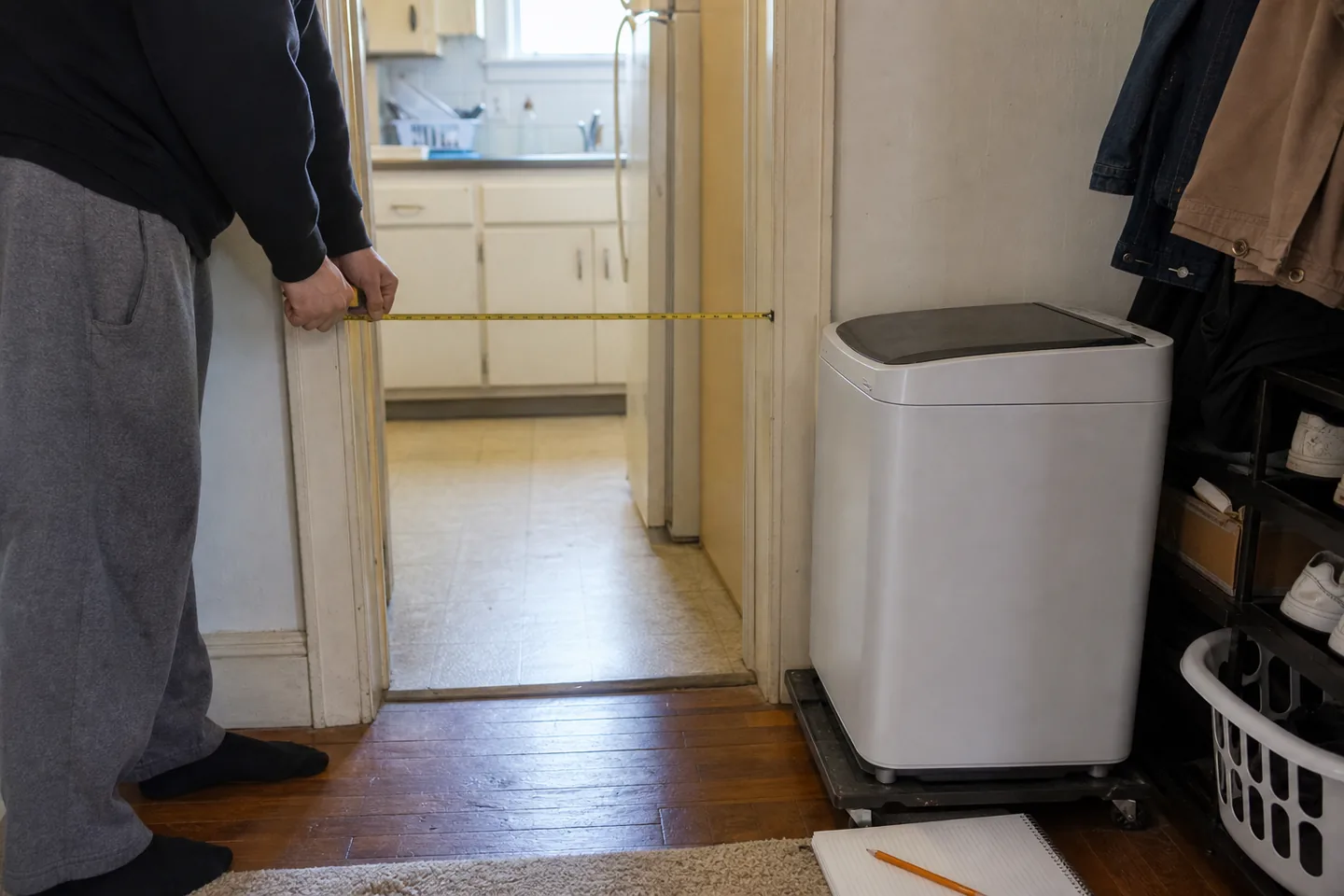
| Moving | Narrowest doorway, turning radius, thresholds, and grip position |
| Operating | Required wall clearance, hose bends, lid opening, faucet reach, and user standing room |
A washer that fits under a counter may not operate there. A top-opening lid needs vertical clearance. Hoses need gentle bends rather than being crushed behind the cabinet.
Use household size as a starting clue, not a formula
One person with uniforms, gym clothes, and towels can create more weekly laundry than two people with a light routine. Household count helps, but these factors matter more:
- how many loads you already run;
- whether laundry can run more often in small batches;
- whether shared machines remain available for bedding;
- how fast the drying area resets;
- how much lifting or rolling is comfortable.
Smaller, more frequent loads often fit apartment life better. They dry faster, reduce basket weight, and make stains less likely to sit for a week. The tradeoff is more setup and connection cycles.
Separate bedding from everyday capacity
Bulky items occupy space, distribute weight differently, and may exceed what a compact machine is designed to handle even when they can be pushed into the drum. Check the manual for explicit item guidance.
A practical hybrid is normal clothing at home and large bedding at a laundromat or shared laundry room. Buying a much larger washer for an occasional comforter can make every ordinary load harder to store and dry.
Make a shortlist with constraints, not stars
For each candidate, copy these details from the current manufacturer manual:
- Exterior dimensions and appliance weight.
- Required operating clearances.
- Faucet or inlet connection method.
- Drain-hose requirements.
- Electrical and grounding requirements.
- Load guidance and prohibited items.
- Cleaning, draining, and storage steps.
Reject any model with an unresolved hard constraint. Only then compare convenience, cycle options, efficiency information, warranty, and price. This order keeps an impressive capacity number from hiding a machine that cannot live comfortably in the apartment.
Sources and verification
We use primary sources where safety, labeling, energy, or moisture guidance is involved. Product-specific instructions always defer to the current manual.
See something that needs an update? Read our corrections process.