Dry without a dryer
Which Drying Rack Works in a Small Apartment?
Compare wing, tower, wall, over-door, ceiling, and flat-dry formats by usable rail length, footprint, stability, storage, and access.
The short answer
- Compare usable hanging length and garment spacing, not the rack's folded dimensions or advertised number of bars.
- Choose a format that remains stable when the heaviest likely items are wet and unevenly distributed.
- Include setup, access, and folded-storage movements in the footprint test.
A drying rack can look wonderfully slim in a product photo and then swallow the only clear path between your bed and the door. The folded measurement tells you where it can hide; the open, loaded measurement tells you whether you can live with it.
The best rack for a small apartment isn’t the one with the most bars. It’s the one that holds your normal load with breathing room and still lets you open a cabinet, walk through the room, and put the rack away when the clothes are dry. Use this comparison alongside the complete no-dryer apartment routine so the rack fits the load—not just the corner where you plan to store it.
Compare the main rack formats
| Format | Useful when | Main tradeoff |
|---|---|---|
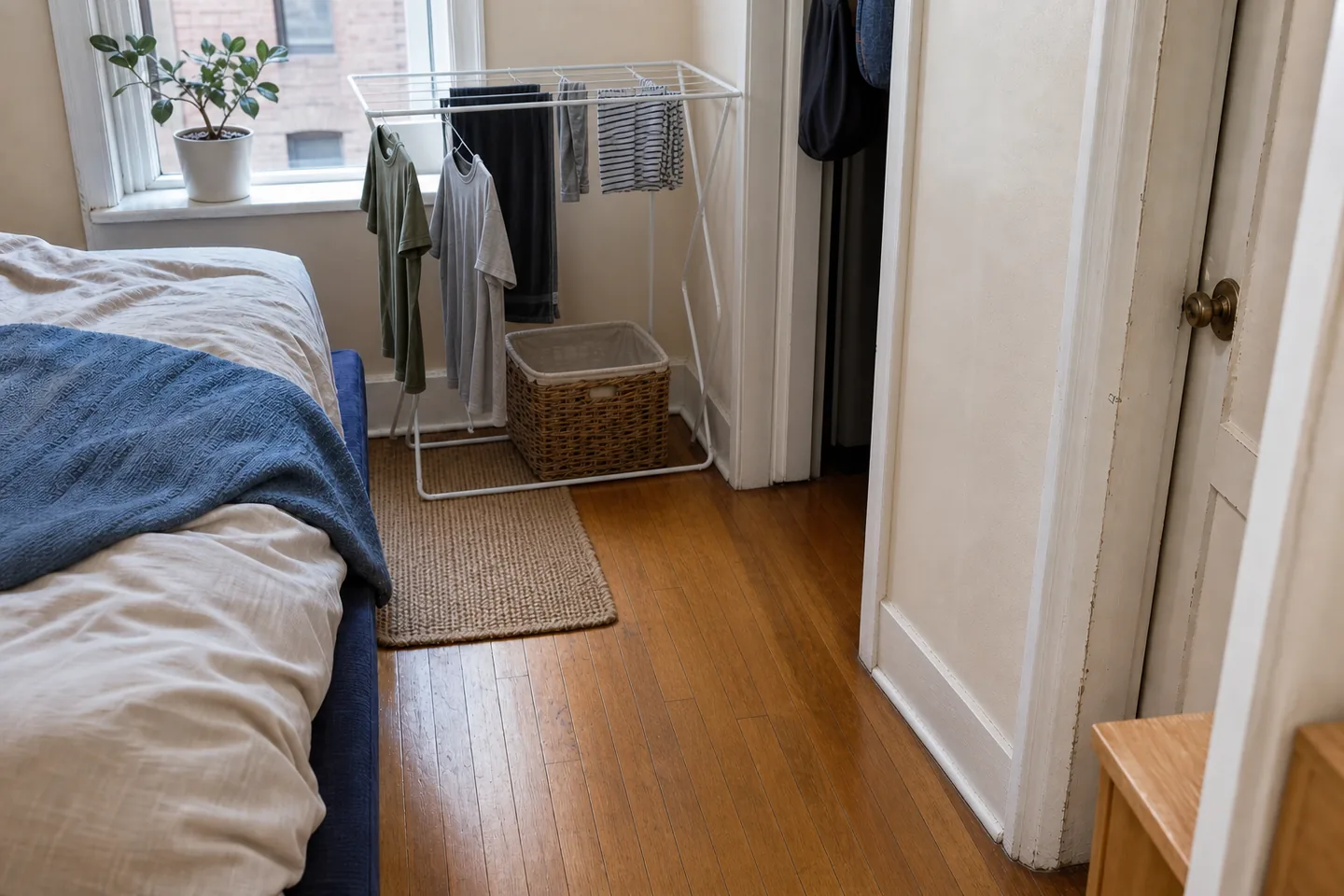
| Wing rack | You need mixed rail heights and easy setup | Wide operating footprint |
| Tower rack | Floor area is tight and vertical space is open | Lower tiers can receive less airflow; access is two-sided |
| Accordion wall rack | A permitted wall can support the rated load | Installation, wall strength, and projection into the room |
| Over-door rack | The door and frame are compatible | Door movement, top clearance, and uneven load leverage |
| Ceiling pulley | The building permits secure installation | Installation complexity and lifting access |
| Flat-dry mesh | Knits and reshape-to-dry items | Large horizontal area per garment |
No single format handles every garment well. Many small homes work better with one everyday rack plus a compact flat-dry surface than with an oversized all-purpose structure.
Calculate usable rail length
Count only rails where garments can hang without immediately touching another layer. Short lower rails may work for socks but not shirts. Closely stacked tower tiers may need alternate bars left empty for thicker fabric.
Use your last normal load as a test list. Assign each item a place on a sketch. Include wide towels, long pants, and flat-dry pieces. If the sketch depends on overlapping fabric, the stated rail count is not usable capacity.
Our drying rack space calculator turns the garment mix into an initial rail-length estimate, but a physical rehearsal remains valuable.
Test the operating footprint
Tape the rack’s open footprint on the floor. Then add:
- the width of hanging sleeves and towels;
- clearance for wings or doors to open;
- a path to reach the far side;
- fan placement outside the splash or trip zone;
- a clear route to exits and frequently used storage.
Leave the tape in place for one evening. Cook, shower, open closets, and move through the room normally. A technically fitting rack that blocks the apartment’s routine is not a good fit.
Treat stability as a loaded condition
Wet towels and jeans shift the center of gravity. Check the manufacturer’s total and per-rail load ratings, locking mechanisms, foot shape, and floor requirements. Load heavier items low and balance both sides when the design permits.
If children or pets share the space, consider whether the rack can be placed outside their path or whether a more fixed, properly installed solution is appropriate. Do not add unapproved weights or wall tethers that change how the rack is designed to stand.
Check setup and storage effort
Open and close the rack in the place where it will actually be used. Look for finger-pinch points, stiff joints, and a folded shape that springs open. Confirm that a wall hook or closet slot is rated and permitted if storage depends on hanging the rack.
Measure the folded thickness at the widest hardware, not only the frame. A rack stored behind a door must not interfere with the door or scrape the wall.
Make a fabric-aware choice
The care label controls whether an item can hang, tumble, or dry flat. A household with many knits needs more horizontal mesh area. A household with shirts and lightweight basics benefits from long uninterrupted rails. Towels and denim need wide spacing and strong rails.
Buy for the recurring fabric mix. Occasional bulky pieces can use a separate laundromat or outdoor solution where permitted, instead of forcing the everyday rack to dominate the room.
Sources and verification
We use primary sources where safety, labeling, energy, or moisture guidance is involved. Product-specific instructions always defer to the current manual.
See something that needs an update? Read our corrections process.