Wash without hookups
Can You Use a Portable Washer in an Apartment Without Hookups?
A renter-first decision guide to permission, faucet connection, drainage, power, movement, and drying before buying a portable washer.
The short answer
- A removable faucet connection solves only the water-supply question; drainage, power, permission, and drying still need separate answers.
- Do a dry setup rehearsal with measurements and an empty route before you choose a machine.
- If the lease or appliance manual conflicts with the plan, stop and choose a laundromat or shared-laundry routine instead.
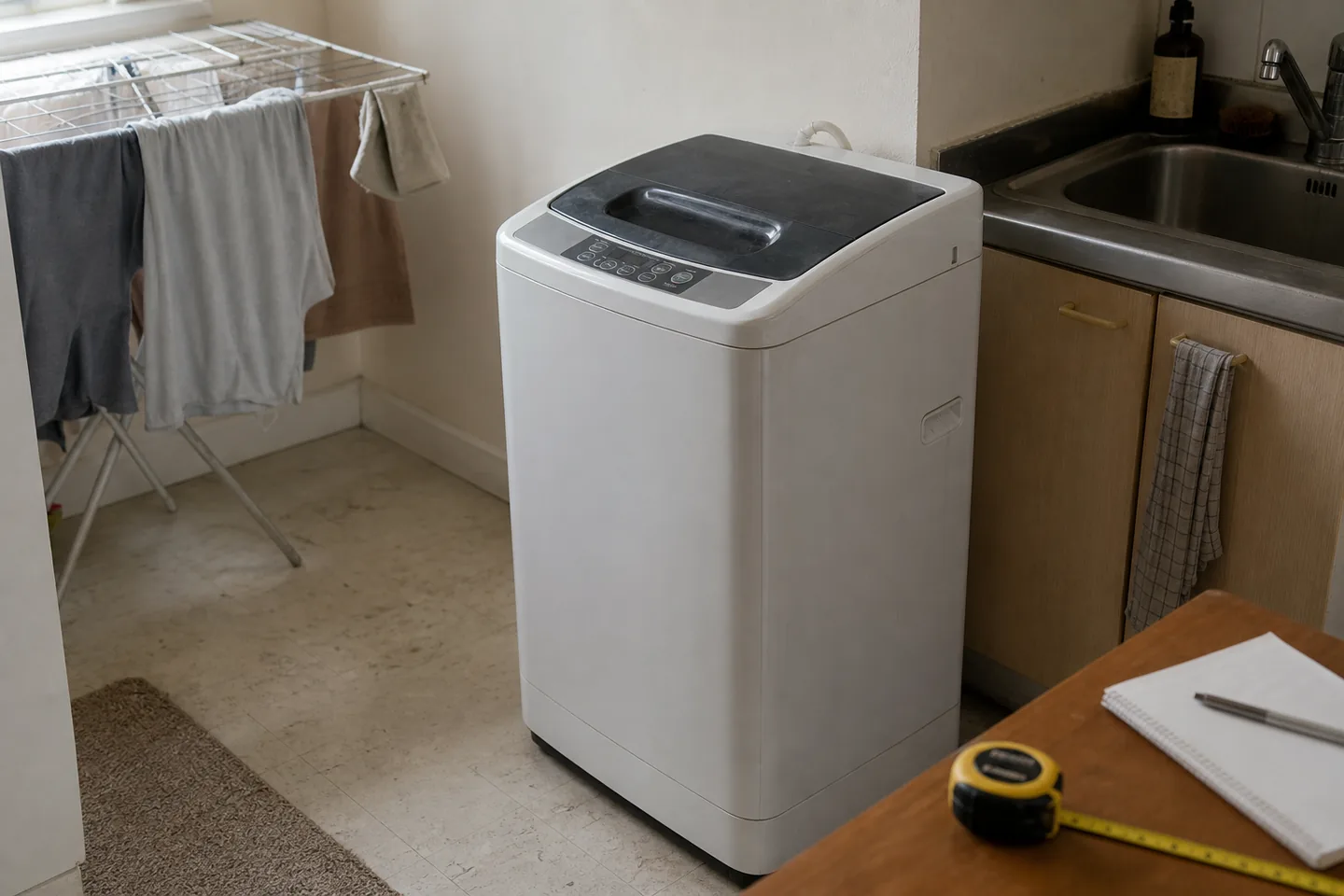
A portable washer can work in an apartment without permanent hookups—but the word “portable” skips over most of the work. The machine still needs an allowed place to run, a compatible faucet, a reliable drain, the right outlet, enough drying space, and a dry place to wait between loads.
So don’t begin with drum capacity. Begin with one pretend laundry day. Walk the route from storage to sink, check the faucet connection, rehearse the drain-hose setup, and make sure the wet load has somewhere to dry. If any step depends on improvising around water or electricity, the setup isn’t ready yet.
Start with permission, not dimensions
Read the appliance section of your lease and any building rules. Search for wording about washing machines, plumbing connections, water-using appliances, floor drains, and liability for leaks. If the language is unclear, ask the landlord or property manager in writing and describe the proposed setup accurately: a portable appliance connected temporarily to a sink, then disconnected and stored.
Do not call it a countertop appliance if it is a floor-standing washer. Clear language gives you a useful answer and a record of it.
If the building prohibits in-unit washers, the project stops here. A clever adapter does not override the agreement.
Walk the complete load path
Measure six things before comparing capacities:
- The storage footprint, including hoses, handles, wheels, and clearance required by the manual.
- The narrowest doorway or turn between storage and the sink.
- The distance from the machine’s operating position to the faucet.
- The distance and height relationship between the drain outlet and the sink.
- The route to the required electrical outlet.
- The drying capacity for the wet load that comes out.
Use painter’s tape to mark the washer footprint on the floor. Walk the empty route while holding a box or laundry basket with similar dimensions. This exposes cabinet handles, bath mats, door swings, and tight turns that a product-dimension table cannot show.
Treat connection and drainage as separate tests
Some portable washers use a combined hose assembly that connects to a faucet after the aerator is removed. That does not mean every faucet works. Pull-down sprayers, square outlets, hidden aerators, damaged threads, and non-removable aerators can block the connection.
Drainage is a different problem. A sink may accept normal faucet flow but still back up when a washer pumps out quickly. The drain hose also has to remain secured in the position and height specified by the manual. A hose that can jump from the basin is not a working system.
Before the first wash, clean the sink drain, remove anything that could block it, secure the hose exactly as instructed, and stay present for the entire cycle. Never treat the first load as an unattended test.
Keep water and power from becoming one problem
Use the outlet and grounding arrangement required by the washer manufacturer. Do not route a cord across a wet sink edge or a traffic path. Avoid adding an extension cord or power strip unless the appliance manufacturer explicitly permits the exact arrangement; unsuitable cords can introduce shock and fire risk.
The safest layout keeps the electrical connection away from hose couplings and splash zones, with enough slack that moving the washer does not pull on the plug.
Confirm the reset routine
After a load, the system still has work to do. You need a place to:
- turn off the faucet and release pressure as directed;
- drain residual water from hoses;
- dry the faucet adapter and connection points;
- leave the machine open or ventilated as its manual recommends;
- wipe the floor and return the washer without trapping a wet hose.
If reset takes too long, the washer will stay in the kitchen or bathroom. Include that reality in the buying decision.
A practical go / pause / stop decision
Go when the lease allows it, the manual matches the faucet and outlet, the sink drains confidently, the route is clear, and one washer load fits your drying setup.
Pause when an adapter, drain rate, outlet, or storage clearance still needs confirmation. Resolve one unknown at a time before ordering.
Stop when permission is denied, drainage is unreliable, the only power plan depends on an unapproved cord, or the wet load has nowhere to dry safely. A strong small-space laundry system may still use a laundromat for washing and a compact home setup for sorting, transport, and storage.
Sources and verification
We use primary sources where safety, labeling, energy, or moisture guidance is involved. Product-specific instructions always defer to the current manual.
- GE Appliances — Portable Washer Unicouple Connection — Example of a manufacturer-specified removable-aerator connection; details vary by model.
- U.S. CPSC — Extension Cords Business Guidance — Explains electrical shock and fire risks associated with unsuitable extension cords.
See something that needs an update? Read our corrections process.