Humidity & airflow
Winter Indoor Laundry Drying Without a Damp Apartment
Adapt load size, airflow, ventilation, humidity monitoring, garment spacing, and finish checks when cold surfaces and closed windows slow drying.
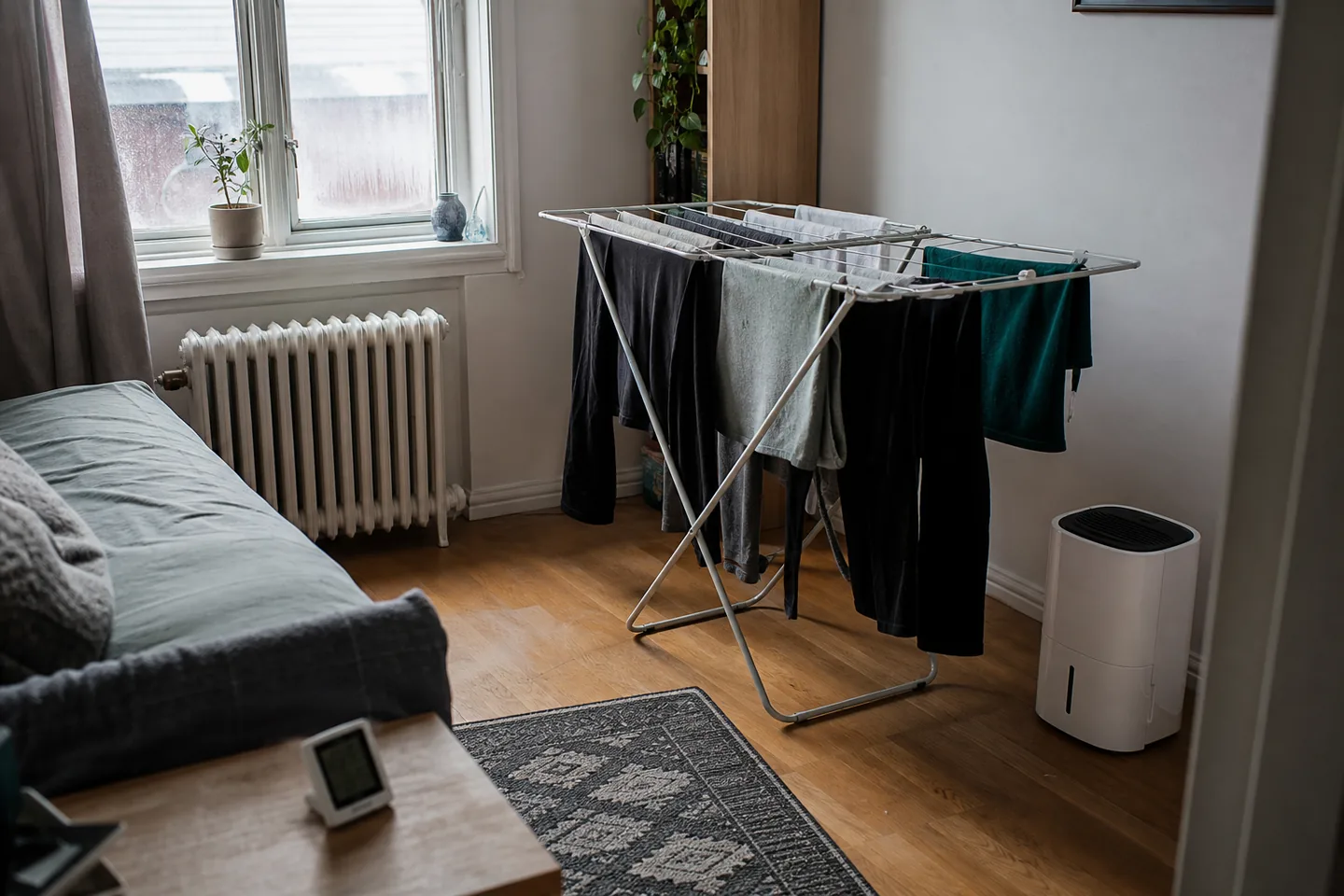
The short answer
- Cold windows and exterior walls can collect condensation even when the rack is elsewhere, so inspect the room perimeter during drying.
- Short, deliberate moisture removal can be more workable than leaving a window open continuously in winter.
- Reduce heavy-item density and use finish checks instead of assuming yesterday's drying time still applies.
Winter laundry can be deceptive: the middle of the room feels warm and dry while the window edge quietly collects water. Closed windows reduce natural air exchange, and cold exterior surfaces give moisture an easy place to condense.
Use the room—not a summer drying timer—as your guide. Begin with the indoor humidity and condensation checklist, then shrink and space the load using the faster indoor drying guide. The goal is steady drying without turning the window, exterior wall, or space heater into part of the laundry setup.
Move the rack away from cold surfaces
Do not press wet laundry or the rack against an exterior wall, window, or uninsulated pipe. Leave enough clearance for air to move and for you to inspect the surface behind it.
Check window corners, frames, and the wall behind furniture during the load. The EPA advises acting quickly when condensation appears: dry the surface and reduce the moisture source.
Avoid placing laundry directly on radiators, space heaters, or heating equipment. Follow equipment clearances and do not create an improvised heated drying tent.
Shrink the winter load
Towels, jeans, sweatshirts, and layered seams dominate finish time. Separate them from lightweight clothing or give them extra rail space. A winter load may need to be smaller than the same rack can handle in summer.
Use an appropriate higher spin to reduce remaining water. Open pockets and hoods, uncuff fabric, and prevent overlap from the beginning.
Treat the first cold-weather load as calibration. Record starting humidity, finish time, and any condensation.
Use deliberate ventilation
Leaving a window cracked for hours may be uncomfortable, insecure, or energy-intensive. When outdoor conditions are suitable, a shorter period of purposeful ventilation can exchange moist indoor air while limiting prolonged heat loss. Cross-ventilation may work faster than one barely open window, but only where security, weather, and building rules permit.
An exhaust fan that vents outside can remove moisture without opening the main room. Air conditioning and a maintained dehumidifier are other tools, though their suitability and efficiency depend on temperature and the home.
A circulation fan helps move air across fabric but does not remove moisture by itself. Pair it with a moisture exit or collection method.
Track humidity in more than one moment
The EPA recommends indoor relative humidity below 60 percent and ideally between 30 and 50 percent when possible; CDC recommends no higher than 50 percent for mold prevention.
Take a baseline before the load, another reading while the load is actively drying, and a final reading after it comes down. The room should trend back toward its normal range.
Remember that a center-room hygrometer may not reveal condensation risk at a cold window. Use the reading together with surface inspection, smell, and drying progress.
Add a winter finish check
Fabric can feel cold simply because the room is cold, making touch less obvious. Press thick seams between dry fingers and compare them with a known dry item. Check both sides, pocket bags, waistbands, cuffs, and the inside of hoods.
Do not fold while uncertain. Give the item a spaced second stage rather than putting it in a closet where air movement drops.
When finished, remove the rack, dry any collected condensation, and keep closet doors or storage bins from receiving damp fabric.
Know when the room is rejecting the load
Stop adding laundry when condensation returns quickly after wiping, humidity stays high, drying stalls, or a musty smell develops. Reduce future loads and investigate ventilation or building moisture. Renters should document and report persistent window leaks, wall dampness, or visible mold.
A successful winter routine is smaller, more observable, and easier to reset—not simply warmer.
Sources and verification
We use primary sources where safety, labeling, energy, or moisture guidance is involved. Product-specific instructions always defer to the current manual.
See something that needs an update? Read our corrections process.